Commercial Vehicle Wallet Storage | CarInteriorMix
If you drive a commercial vehicle?delivery van, work truck, shuttle, or fleet car?your wallet and daily essentials are exposed to more risk than most people realize. You?re in and out of the cab, stopping in busy areas, leaving doors open during loading, handing paperwork to customers, and sometimes sharing the vehicle with coworkers. That mix of frequent stops and predictable routines is exactly what opportunistic thieves look for.
Secure wallet storage inside a commercial vehicle isn?t just about preventing theft. It also reduces distraction (no more searching under seats), keeps cards and cash from getting damaged, and helps you stay organized with IDs, fuel cards, receipts, and access badges. The goal is simple: keep valuables accessible to you, and inconvenient?or invisible?to everyone else.
This guide walks you through the best secure storage methods for wallets in commercial vehicles, how to choose the right products, where to mount them, and the common mistakes that undermine security. You?ll also get step-by-step setup instructions and real-world examples from typical workday scenarios.
Why Wallet Security Matters More in Commercial Vehicles
Commercial driving has unique realities that create security gaps:
- High stop frequency: Every stop is a new opportunity for a grab-and-go theft.
- Open-door habits: Loading/unloading often means doors stay unlocked.
- Predictable routines: Similar stops, similar times, same parking spots.
- Shared vehicles: Fleet use increases chances of misplaced or exposed valuables.
- More visible gear: Tools, packages, and equipment can attract attention?wallets get taken along with everything else.
Even if your wallet isn?t stolen, the consequences of losing it mid-route can be expensive and stressful: missed deliveries, time lost canceling cards, replacing IDs, or dealing with fraudulent charges. A small upgrade in storage and habits can prevent a big disruption.
Threats to Plan For: What Actually Happens in the Real World
Smash-and-grab at quick stops
A thief watches you step out for ?just a minute,? breaks a window, and takes anything visible?wallet, phone, bag, paperwork.
Door checkers and parking lot prowlers
Unlocked doors are common during loading. A quiet door pull is faster than breaking glass.
Inside access (shared vehicles)
In fleet situations, you may have coworkers, service techs, or supervisors in the cab. Most people are honest, but ?wallet left in console? can become ?wallet missing? quickly.
Loss by sliding/falling
Wallets fall between seats, slide under floor mats, or end up in door pockets. That?s not theft?but it creates panic, delays, and can lead to leaving the vehicle to search in unsafe areas.
Choosing the Right Secure Storage Approach
There isn?t one perfect solution for every driver. The best method depends on your vehicle type, how often you exit the cab, and how much you carry. Below are the most effective options, from simplest to most secure.
1) On-body carry (best for frequent stops)
If you?re constantly in and out, the safest wallet is the one that never leaves you.
- Front-pocket wallet: Harder to pickpocket and less likely to fall out.
- RFID-blocking slim wallet: Helps protect contactless cards in crowded areas.
- Money belt or inner-pocket pouch: Great for high-cash routes (events, tips, service calls).
Best for: delivery drivers, couriers, technicians with 30+ stops/day.
2) Lockable center console or glovebox (good baseline)
Many trucks and vans have lockable compartments. They?re convenient, but don?t assume they?re high-security?some are easy to pry or share the same key as other locks.
Best for: drivers who need quick access but still want basic deterrence.
3) Under-seat lockboxes (best blend of security and convenience)
A compact steel lockbox secured to a seat frame with a cable is one of the most practical upgrades for commercial vehicles. It?s not a full safe, but it stops quick theft and keeps wallets out of sight.
- Cable-attached lockbox: Quick install, portable, works in most vehicles.
- Bolted lockbox: More secure, better for owner-operators.
- Combination vs key: Combination avoids lost keys; key is faster if you manage it well.
Best for: service vans, work trucks, rideshare/taxi operators, field sales.
4) Vehicle safes (highest security inside the cabin)
Purpose-built vehicle safes bolt to the floor, seat base, or cargo-area mounting points. If you carry cash deposits, multiple company cards, or sensitive IDs, a real safe is worth it.
Best for: armored transport (light-duty), high-value delivery, contractors carrying company funds, fleet managers protecting shared assets.
5) Hidden compartments (use carefully)
Hidden storage can work, but it?s not a substitute for a lock. If someone knows your model well, ?secret? spots aren?t secret for long. Use hidden compartments for low-value items or as a secondary layer.
Where to Store a Wallet in a Commercial Vehicle (Ranked)
Location matters as much as the product. A thief?s first targets are the most obvious ones.
Best locations
- Under the seat in a lockbox: Out of sight, difficult to access quickly.
- Bolted safe in cargo area (if you don?t need constant access): Less visible than cabin storage.
- Inside a locked compartment with no external visibility: Better if the compartment is sturdy and not obviously ?where valuables go.?
Locations to avoid
- Door pockets: Visible when the door opens and easy to grab.
- Center console top tray: First place most people look.
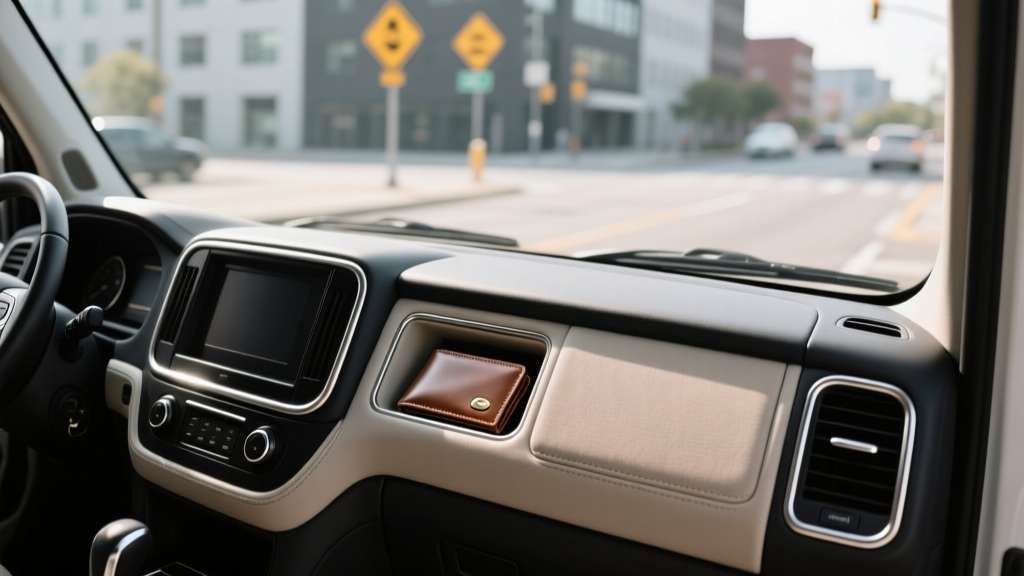
- Dashboard cubbies: Highly visible through windows.
- Seat back pockets: Easy for passengers/coworkers to access.
- Glovebox with manuals and paperwork spilling out: Signals ?there?s stuff in here.?
Step-by-Step: Setting Up Secure Wallet Storage That Works Daily
Step 1: Map your ?exit routine?
Write down what you do when you stop:
- Do you leave the vehicle running?
- Do you lock the doors every time?
- Do you carry the wallet, or leave it in the cab?
- How long are you away from the vehicle on average?
Real-world example: A delivery driver making 60 stops/day usually benefits most from on-body carry. A contractor who spends 30?60 minutes inside buildings benefits from a bolted safe or under-seat lockbox.
Step 2: Choose your security level
Use this simple decision guide:
- Wallet always on you: Choose a slim, durable wallet + consistent habit.
- Wallet sometimes left in vehicle: Get an under-seat lockbox with cable at minimum.
- Cash deposits/company cards/sensitive IDs: Install a bolted vehicle safe.
Step 3: Install a cable lockbox (quick method)
- Pick a box size: Big enough for your wallet, phone, keys, and a small envelope. Avoid oversized boxes that are hard to hide.
- Choose an anchor point: Seat frame metal is ideal. Avoid plastic trim and wiring bundles.
- Route the cable: Loop through the seat frame and keep slack minimal so the box can?t be pulled into view.
- Place the box: Under the seat toward the center tunnel is typically less visible from outside.
- Test seat movement: Slide the seat fully forward/back to confirm the cable won?t snag.
- Set your combination (if applicable): Use a code you?ll remember without writing it on a sticky note in the cab.
Step 4: Improve ?visual security? in the cabin
Even the best lock is helped by a low-profile cabin:
- Keep bags and jackets off seats when parked.
- Use dark window shades only where legal and appropriate for your area.
- Store receipts, fuel cards, and badges in a single organizer so they?re not scattered.
- Avoid leaving charging cables and phone mounts visible if they imply a device is stored inside.
Step 5: Build a two-second habit
The most secure setup fails when habits slip. Try a simple rule:
- If you exit the vehicle: wallet on you or wallet locked?no third option.
- If you?re more than 10 feet away: doors locked, every time.
Product Recommendations and Comparisons (What to Look For)
Rather than chasing the ?most expensive? product, focus on features that matter in commercial use.
Lockbox vs vehicle safe: quick comparison
- Cable lockbox
- Pros: Affordable, easy install, transferable between vehicles
- Cons: Less secure than bolted safe, cable can be cut with tools
- Best for: everyday wallet storage, short stops, general deterrence
- Bolted vehicle safe
- Pros: Strongest option, best against smash-and-grab
- Cons: Higher cost, requires installation, not easily moved
- Best for: high-value routes, shared vehicles, cash handling
Key features to prioritize
- Steel thickness and build quality: Avoid flimsy ?security? boxes that flex easily.
- Secure hinge design: Concealed hinges are harder to pry.
- Mounting method: Bolt-down is stronger than cable; cable is still better than nothing.
- Lock type:
- Mechanical combination: Reliable, no batteries
- Keyed lock: Fast access, but don?t leave the key in the vehicle
- Electronic keypad: Convenient, but consider battery maintenance
- Interior padding: Helps protect cards, screens, and prevents rattling.
Practical ?fit? recommendations
- Compact lockbox: Ideal for wallet + phone + keys; easiest to hide under seat.
- Medium lockbox: Better if you also store a small tablet, passport, or checkbook.
- Vehicle console safe (model-specific): Great if you want an OEM-style look and quick access.
Common Mistakes to Avoid
- Leaving the wallet in plain sight ?just for a minute?: Most thefts happen fast, often under 30 seconds.
- Relying on the glovebox alone: Many gloveboxes are easy to force and are a thief?s first guess.
- Hiding the wallet without locking it: Hidden isn?t secure, and experienced thieves know the usual hiding places.
- Storing the spare key in the cabin: That defeats the purpose of keyed security.
- Using a lockbox with a long, loose cable: It can be pulled into view, making it a target.
- Forgetting about ?secondary items?: Fuel cards, toll tags, access badges, and spare phones can be even more valuable than cash.
- Not considering passengers: If you drive clients or coworkers, keep wallet storage out of reach and out of sight.
Advanced Tips for Fleet Drivers and Owner-Operators
Set a standard operating procedure (SOP)
If multiple drivers use the same vehicle, create a consistent system:
- Driver wallet stays on-body; company cards go in a locked safe.
- Assign a single location for receipts and delivery paperwork.
- Use a checklist at shift change: ?Remove personal items, confirm compartments locked.?
Use separate storage for company assets
Keep personal wallet storage separate from business-critical items:
- Personal wallet: on-body or lockbox
- Company fuel card: locked compartment with limited access
- Cash deposits: bolted safe, ideally away from the cabin
Think about what thieves see first
A clean, empty-looking cabin is a security feature. Even if you have secure storage, reducing visible temptation lowers the chance of a break-in.
FAQ: Commercial Vehicle Wallet Secure Storage
Should I leave my wallet in a lockbox while driving?
It depends on your route and comfort. Many drivers keep the wallet on-body for quick stops. If you prefer to store it, a lockbox can reduce clutter and prevent it from sliding under seats. Just make sure you can access ID or payment when needed without fumbling.
Are RFID-blocking wallets worth it for commercial drivers?
They can be, especially if you?re frequently in crowded pickup areas, events, or public transit hubs. RFID blocking helps reduce the risk of unauthorized scans of contactless cards. It?s not a replacement for physical security, but it?s a smart layer.
Is a cable lockbox secure enough to stop theft?
It?s strong deterrence against quick thefts and door-checkers, and it keeps valuables out of sight. It won?t defeat a determined thief with time and tools, but it dramatically improves real-world security compared to consoles and gloveboxes.
Where?s the worst place to keep a wallet in a work truck or van?
Door pockets and the center console tray are top ?worst? spots because they?re obvious and easy to grab. Anything visible through the window is also high risk.
What?s the best setup if I share my commercial vehicle with other drivers?
Use a bolted safe or a lockbox that only you can open, and keep personal items minimal. For fleets, a dedicated safe for company cards and devices?managed with a controlled access method?reduces confusion and loss.
Should I store my wallet in the cargo area safe?
If you don?t need frequent access and your cargo area is secured and out of view, it can be a good option. For delivery routes with constant stops, on-body carry usually works better.
Actionable Next Steps
- Pick your method today: on-body carry, under-seat lockbox, or bolted safe.
- Clean up the ?temptation zone?: remove visible bags, loose cash, and scattered cards from the cabin.
- Install and test: ensure seat travel, cable routing, and access are smooth in real use.
- Commit to a simple rule: wallet on you or wallet locked whenever you exit.
A secure wallet strategy is one of those small changes that pays you back every day?less stress, fewer delays, and a cab that feels organized and professional. For more practical interior security and storage tips, explore additional guides on carinteriormix.com.